
Developer Center
Build and Connect Social Media Publishing with Blog2Social
Find the APIs, SDKs, MCP tools, AI resources, automation integrations, and technical documentation you need to add social media publishing to your application, AI environment, or workflow.
Choose the integration path that fits how you want to build: work directly with the REST API, use an official SDK, connect AI assistants and agents through MCP, or automate social media publishing workflows.
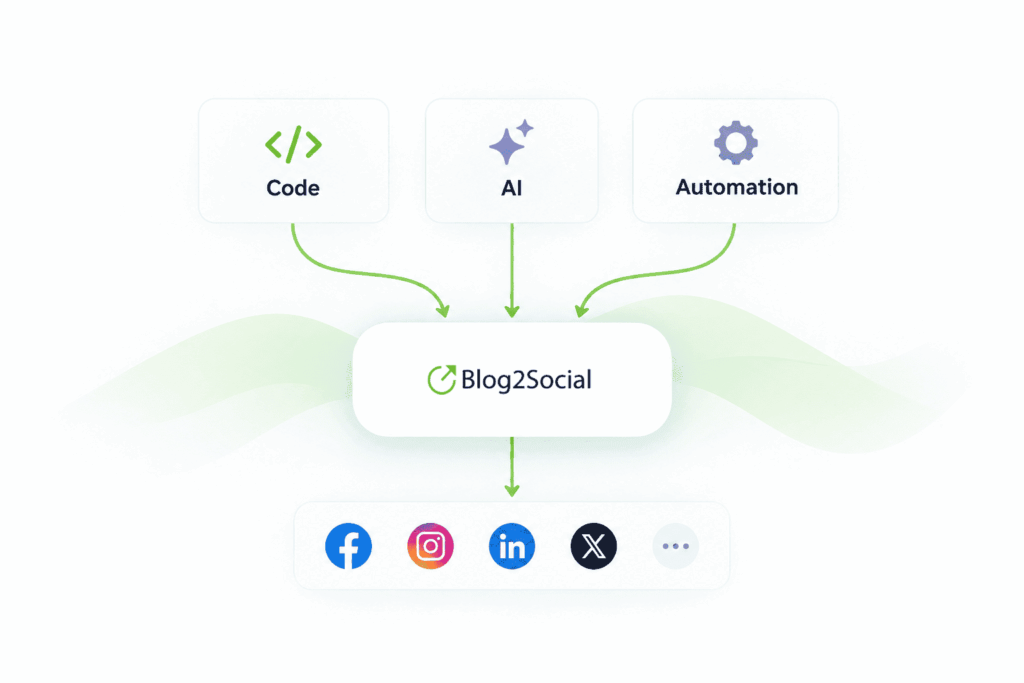
How it fits together
One platform. Many integration options.
Connect your application, AI assistant, or workflow to Blog2Social. Use one platform to manage connected accounts, publish content, and access insights.
Build & Integrate
For custom applications and backend integrations
Connect AI
For AI assistants, agents, and automation workflows
REST API
Direct programmatic access to Blog2Social using HTTP requests.
For developers · Coding required- Full API endpoints
- Flexible integration
- Ideal for custom applications
Official SDKs
Use our official SDKs for Node.js or PHP.
For developers · Coding required- Node.js SDK
- PHP SDK
- Ready-to-use integration tools
AI API Specification
Give an AI coding assistant the machine-readable API specification.
For developers using AI coding tools- Machine-readable specification
- Use with coding assistants
- Build custom integrations and tools
Blog2Social MCP Server
Connect compatible AI applications directly to Blog2Social.
For AI assistants, agents, and MCP clients- Hosted MCP Server
- OAuth authentication
- Use natural-language instructions
One platform.
Many integration options.
Learn
Understand the concepts
Start here to understand the technologies and architecture behind social media publishing integrations. Learn how APIs, authentication, AI, and MCP fit together before choosing your implementation path.
Build
Choose your implementation path
Choose how you want to integrate Blog2Social: build programmatically with the REST API and SDKs, connect AI assistants and agents through MCP, or create automated social media publishing workflows.
Build with Code – Use Blog2Social REST API for social media publishing
Direct REST access gives you full control over request handling, responses, and your application architecture. Build directly against the Blog2Social REST API or use an official SDK for your technology stack. Direct REST access gives you full control over requests, responses, and your application architecture.
Social Media REST API
Integrate the Blog2Social REST API for social media publishing from any programming language or backend capable of sending HTTPS requests.
Best for: Custom integrations, any-language applications, enterprise systems, full control over requests.
Social Media API Code Examples
Start quickly with implementation examples that can be tested directly or adapted to your own environment.
Available examples: cURL requests, shell scripts, authentication workflows, connected-account requests, publishing calls, media workflows, and error handling.
Official Blog2Social API SDKs for social media publishing integration
Use a language-specific SDK to integrate the Blog2Social REST API with reusable classes for authentication, account management, and publishing to reduce repetitive HTTP code while retaining access to the underlying Blog2Social REST API.
Node.js SDK
Build social media publishing into Node.js and TypeScript applications with the official typed, Promise-based SDK.
The Node.js SDK simplifies authentication, connected accounts, publishing, insights, user apps, network properties, and video uploads.
PHP SDK
Integrate authentication, connected accounts, publishing, and media workflows into Composer-based PHP applications with the official object-oriented SDK.
Best for: PHP applications, SaaS platforms & CMS plugins, Composer-based projects, faster implementation.
Automate
Connect AI assistants and agents to Blog2Social
Connect AI environments directly through the hosted Blog2Social MCP Server, or use the AI API Specification to build custom applications, integrations, SDKs, and AI tools with coding assistants.
Social Media Workflow Automation
Look up endpoints and implementation details
Find the technical details you need while implementing or troubleshooting Blog2Social integrations, from REST API endpoints and MCP configuration to network capabilities, authentication, responses, and MCP distribution.
FAQ
Frequently Asked Questions
Ready to build?
Choose the integration path that fits your project, whether you want to build with the API and SDKs, connect AI through MCP, or automate social media publishing workflows.